

Return Mycelial
On parasociality, illness, and the ecology of global collapse

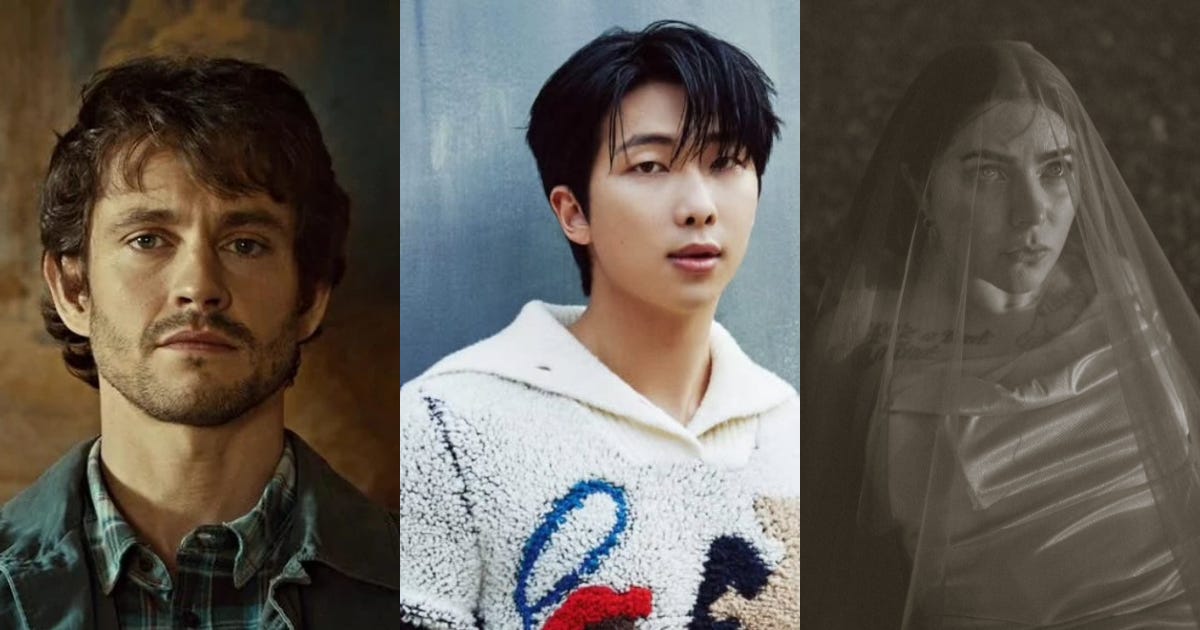
My favourite show is Hannibal. I’ve always identified with the lead character, Will Graham. He’s an FBI consultant, never cleared for active duty. He can ‘connect the dots’ in an uncanny way—pure empathy. He can assume the role of the killer. This, of course, comes at a price for his mental stability.
When consulting on a case, he meets forensic psychiatrist, Hannibal. Hannibal and Will develop an odd relationship. They work together on cases, solving them—often when Hannibal is the perpetrator. Hannibal helps Will stay sound of mind via regular psychology sessions. And, eventually, Will starts to believe that he is the ‘ripper’ he’s looking for while inching closer to discovering who Hannibal really is.
I remember staying up late at night when the show first came out in 2013. There was something about how Will said, ‘This is my design,’ while embodying the killer, that stuck with me. I’d have nightmares for weeks while watching the show. But they eventually subsided as I grew familiar with ultraviolence. I was thrilled to see I shared a birthday with Hugh Dancy, who played Will, June 19. I felt it was a dot to be connected.
What I didn’t understand then was that what drew me to Will Graham wasn’t just identification but instead, a rehearsal. Years later, as my body collapsed during the first onslaught of the pandemic, as parasocial intimacy with an idol rewired my nervous system, and as the world itself began to burn, I would come to recognise the same pattern everywhere: the erosion of boundaries between self and system, body and culture, illness and ecology. This essay traces how becoming an artist, a fan, and a sick body inside a collapsing world exposed me as something else entirely… not broken, but porous.
In 2020, I rewatched Hannibal over Christmas. I drew comparisons to the relationship of power, domination, and control he had with Hannibal to my own with K-pop’s RM, of BTS fame. A year earlier, I had written my first book about the parasocial relationship between myself and RM—how it was something I couldn’t escape.
But there was something deeper. I had been sick. It started slowly in January as I was preparing for a powerlifting competition. I had been cutting weight for weeks, but nothing was shifting. On the full moon, it felt as though my body was being squashed between two giant hands. I asked my then-partner to drive me to the beach to see the moon rise over the ocean. I was desperate for salvation.
This feeling ebbed and flowed. I finished writing my book and learnt how to publish it myself. I’d wake at 2:22 AM with a racing heart, anticipating what would happen next. My powerlifting competition came and went. I didn’t make weight. My body felt broken. Then, by June, with the book published and the eyes of thousands of new fans—and foes—on me, I collapsed. I couldn’t get out of bed. I couldn’t talk. Or walk. Or eat food. I had nothing. I couldn’t even think.
So here I was, December 2020, after months of prescribed complete bed rest, where all I could do was binge Netflix and watch the world fall apart around me. I had been given an experimental treatment. It was proposed that I had a low-level viral infection that had depleted my mind and body. The theory was that if I were given a mix of two viruses—cytomegalovirus and mononucleosis—it would bring forth the infection and force my body to fight it.
As I watched Will struggle with a fever while he slowly lost touch with reality, I couldn’t help but see myself. It turned out that he had a brain infection, and at the same moment of watching it, so did I. And just like him, I had lost my mind.
Three years later, I sat and watched Hannibal again. This time, I was thinking of how I could write about that time of my life. The mystery illness, the fever, losing my mind… losing myself. All while watching the world, throughout the pandemic, burn.
Like many great deep ecologists and feminists who have come before me, I see myself, and all beings, bodies, spaces and places, as part of the same ecosystem. Getting sick during the pandemic only heightened my awareness of our immense interconnectedness. It’s like I knew it in theory, but I never knew it in embodied practice until it was thrust onto me.
In the episode of Hannibal I was watching, bodies were found in the woods. They had been buried in shallow graves, connected to a slow-dripping medication, and had mushrooms growing out of their chests.
Will explains that the killer sees the victims’ bodies as part of an interconnected organism. The killer created a mycelial growth pattern, connecting victims like nodes in a system. He gave them meaning, purpose. He was looking for something. And truthfully, so was I.
It was here that I fully connected the dots. Or rather, the mycelium in me reached for the mycelium in the vast ecosystem of the world—begging for healing. For connection.
A fine nerve
A book I recently published invoked Artaud’s idea of the artist as a ‘fine nerve meter’. I think, over time, that’s what I became. A frayed nerve. My wires showing. The wind sending razor blades about my being. My body was so sick that I began to tap into things—universal radio waves, secrets, divine knowledge—without even trying. I was a hyper antenna, but all the information I received—no matter how good, how timely, how comforting—only served to hurt me. Flay my skin and leave me out in the salt air. When I sought God’s face, to beg him to either save me or end me, I only saw a dark abyss over which I superimposed my likeness.
It all started when I sought to become an artist. I had been an entrepreneur since the age of 19, bootstrapping an array of businesses into existence. In and amongst my business pursuits, I studied creative writing and sociology at university. I woke up at the start of 2019 and realised, despite all my many lives, I had not yet become the person I had dreamt of as a child. The artist. So, I sold my deli and went all in on being a writer. Getting a book published. Becoming her.
This set off a chain of events that brought me into close orbit with a supernova. One day, while eating toast at the kitchen island, laptop playing YouTube in front of me, I saw them. Or rather, I saw him. A man with alien eyes and blue hair. He looked at me as if we knew each other. Not from this lifetime, but the one before, and perhaps the next, too. He was the ringleader, RM. They were a South Korean septet, BTS. I watched as they exploded into a thousand tiny balls of light across the night sky. I had arrived just in time for their tremendous ascent to the upper echelons of stardom. Them, the all-singing, all-dancing, smiling faces of late-stage capitalism. I, but one of millions, if not hundreds of millions.
Yet his eyes only saw me. And, over time—though far quicker than I’d like to admit—I only had eyes for him. Karl Marx would be rolling in his grave like a rotisserie chicken. I went from reading Das Kapital to googling ‘RM BTS girlfriend’ in less time than it took to radicalise me in the first place. The two wolves within me nipped at my proverbial heels as I walked the tightrope between Marxist feminist and becoming a fangirl of a group who were omnipresent. Inescapable.
I wanted to be a star, just like RM. I couldn’t sing nor dance. I could, however, create worlds, ideas, move people. I saw him do the same. My first thoughts upon seeing him were many, but one in particular stood out: I’m going to write a book about you… with you. I could see all of him. I felt I could understand him deeply. Our emotional maps, when overlayed, told a deeper story; whispered promises of a maybe future.
Over the course of the year, I worked diligently to turn myself into a writer. First, I started writing a fiction book. But then, when the romantic lead morphed into RM, and I erred on the side of fanfiction, I turned to scholarship. I wrote about him. About BTS. Then, in September, I was on a writers’ residency in South Australia. I came face-to-face with my shadow self. The one who feared becoming a deranged fan. A monster. Someone who would eat RM whole, as the K-pop idol system so desired. I returned home changed forever—allowing myself to be a clusterfuck of complexities and contradictions. And with shaking hands, and a ‘fear journal’ fast filling up, I started to write my first book in earnest. Of course, it was about him.
This was my encounter with the divine… The bliss… The terror. Writing the book unmade me and remade me—but in which image, I am unsure. I became red raw. Bleeding from my eyes. Writing at the speed of ever-caffeinated fingers that would shake without keys beneath them. I plumbed the depths of my psyche. Like Dyer, I dived off the coastline of my being and searched for pearls beneath frothy waves.
I’d write of a morning—often starting by 6 AM. It was summer. Hot, sticky, oppressive. As was the Queensland way. I’d write until noon and then break for lunch. Often lying down in my bed and staring at the ceiling, I’d cry with frustration when my mind would shut down for the day—darkness threatened to consume me. By 2 PM, I was at the gym. I was in a caloric deficit, training to compete in the under 56kg class for powerlifting—I was going to qualify for the state championship. I was not born to be small, nor skinny. Yet it was a challenge I wanted to put myself through. Be strong. Be small. Look like an author working with RM in South Korea would look. All while writing a book that had me communing with the darkest parts of me—and society—on the regular.
Powerlifting was about discipline. This was a discipline I carried over to writing. And much like powerlifting, writing was about pushing and pulling. Above all else, it was about control. And when I wrote, I relinquished all control unto the abyss. Yet within that, I carefully controlled how I would be perceived, I policed myself, even in my mind. RM would appear, baton in hand, ready to reign down upon me. 38 writing sessions later, in the haze of a new year, my book was finished. And just like that, I had become the writer I had always dreamed of.
Yet, I couldn’t help but feel something was wrong with my body. I knew for certain something was wrong with my mind. I had a never-ending loop of rumination: about RM, about pushing my career forward, about getting stronger and fitter. It wouldn’t stop—it tormented me. I could only see myself through RM’s eyes, and all I saw was a girl flailing around like a fish on hot concrete. I hated that he had such control over me. That all I wanted was for him to love me, to see me, to pick me up from my desolate town and whisk me away someplace new. I used him as both carrot and stick. In the end, he was more stick than anything else.
When I woke up in February, in the early hours of the morning before my powerlifting competition, there was a pit in my stomach. My body swam. No wonder, since I had completed a whopping 8L water cut wherein I virtually drowned myself to lose weight. But it hadn’t worked. I was still a kilo over. As I sat in the car, three layers on and the heater blasting in the middle of summer, my friend begged me to stop. I was distressed, distraught that all my hard work was slipping away. I heard her. But of course, I competed anyway.
When I unracked the weight for my opening squat, I felt it compress my spine and threaten to send me straight through the floor to hell. I took a deep breath, stilled my mind, and descended until my hips passed my knees. With all my might, I pushed upwards and stood perfectly still until I heard the ‘rack!’ command. After the competition, the weight dropped off me and continued to melt away. I had abs. For the first time, I had abs. But I was frail, and despite being able to lift phenomenal weights, I was weak.
In March, I released my first book. On the cover was an artist’s take of my portrait, I’m looking at the reader, a mask in my hand. The mask is RM’s face. I’d wake up at the strangest times, anticipating the worst. I was going viral on Twitter and then TikTok. People were talking about me. Each time I opened my phone, my heart would race so fast I thought I’d pass out. Adrenaline coursed through my veins, but never when I needed it. It came while I slept and made me sit upright in bed, concerned something terrible had just happened. In the quiet of the morning, my chest would THUD THUD THUD! Even worse, I couldn’t keep myself away from my phone. From the internet. I went all in on promoting my book, but that meant opening myself to tens of thousands of people who read the darkest parts of me. Tens of thousands of people who had an opinion. It was the beginning of the pandemic, and because much of the world was locked inside their house, I had an ever-growing audience.
Soon, anger ripped through me. I was consumed by frustration that my book wasn’t selling how I thought it would. Frustration at my own limitations. I’d wake up so mad at the world… At him. I wanted more.
I blinked, and it was June. I awoke one morning and realised I couldn’t get out of bed. A feeling of dread washed over me. My heart raced. I had nothing to give. It was early. I walked to the kitchen and sat down at the table. I said nothing. I couldn’t even look up. My mother was there, and after a moment became concerned. She fed me, but I could barely eat. I shuffled back to bed and stared at the wall. Not a single thought in my head. Yet my heart raced, and I could feel my body on edge. This was how I stayed for most of the month.
On most days, I’d cry. I’d fantasise about dying. My 28th birthday approached, and I had nothing to live for. I wrote the book, but I burnt myself out in the process. I was stuck oscillating between suicidal and numb.
Yet, somehow, I still showed up. Meetings with authors, public talks, writing essays and articles. I’d rally for a moment, an hour or two. Then the crash would drag me back under. Exercise would have the same effect. Coffee, too. A momentary high, then a low that would stretch for days and weeks. When I was on, I was on. And often, when the interview went well, when the post went viral, I’d feel free. As if the entire cause of my demise was simply an incongruence between effort I’ve put in and feedback I’ve received from the universe. A break in the reciprocal see-saw of creative life. But as time progressed, I only got worse.
My doctor took my vitals and asked me if I had group sex or sex with monkeys. When she called me to give my results, she told me my levels were fine, and my liver enzymes were normal for someone with obesity.
“I’m a 56kg competitive powerlifter,” I remember replying through gritted teeth.
A pause.
“Oh, you’re not obese.”
“So would that suggest something’s wrong with my liver enzymes?”
“No, it’s normal if you’re a binge drinker.”
“I haven’t been drinking.”
“Well, it’s fine.”
I do wonder what she would’ve done if indeed I’d had sex with a monkey.
In October, I was instructed by my naturopath to take an entire month off work. I needed complete rest. I nearly burst into tears when she told me how long it’d take to recover—up to five years, if not more.
She gave me tiny vials of viruses and tasked me with taking them regularly. I was to bring on a fever to build my immunity back up. She was confident this would work.
I dripped the viruses into my mouth twice a day. Each time I did, my face would flush red. Eventually, as I progressed to larger doses, I’d get a headache instantly. Then, after a while, the fever began to take hold. It gripped my body and squoze.
Circus music blared in my head, and I could only think about RM on repeat. Replaying scenarios where we’d meet. I’d nip and tuck every last part of me until I was perfect. Then I’d roll the cameras and watch as we experienced serendipity over and over and over.
I cursed RM. I cursed him to hell. Every announcement, every update, every selfie… like nails across my paper-thin skin. His career was taking off most unexpectedly. He had everything I didn’t, and I hated him for it. Yet I lived inside his brain, just inches from occupying his skin. I knew his feelings like my own. I’d get motion sickness while lying down, and feel my ears pop—20 minutes later, I’d look at my phone to see an announcement that he was in the air. I felt it all. Every last minutiae. I was in love. And I hated it. Needless to say, I lost my fucking mind.
This is my design
In Hannibal, Will could step into anyone’s skin. See the world through their eyes. Feel their emotions, think their thoughts. He would attend crime scenes and replay them from the killer’s perspective. But often, he would have visions outside of work hours. Often, he would over-identify with the killer. He soon feared that he was one himself.
This is where Hannibal came in to help. A skilled psychiatrist, he would provide Will with therapy. Unbeknownst to Will, of course, was that Hannibal was often the killer. And to cover his tracks, he would find other killers and offer them up on silver platters. Just as he’d offer his FBI friends the flesh of his victims in astonishing culinary feats.
Will and Hannibal were two men, locked in a dance of recognition, intuition, projection, and hunger. Hannibal opened Will up, widened his perception, flayed him psychologically. Will, in turn, became Hannibal’s finest artwork—his magnum opus, sculpted through terror, intimacy, and psychic violation.
What fascinated me most wasn’t the violence. It was the porosity. The dissolving of boundaries. The way Hannibal slipped into Will’s mind and Will slipped into his, until the two of them were caught in a feedback loop of understanding so precise it became destructive. They saw each other too clearly, too wholly. Too intimately.
This is what I experienced from the first moment I saw RM. This is what captured my imagination so intensely. This is what grew and festered—fostered, nurtured, cultivated—until it became the engine that allowed me to write my book. The uncanny parasocial limerence between an idol and their most loyal fan. Throughout my descent into the BTS fandom, I wasn’t being groomed into madness by a cannibal psychiatrist… I was becoming porous. Hyper-attuned. A fine nerve exposed to every signal in the ecosystem. Ironically, this—more than any workshop, degree, or discipline—is what turned me into an artist.
Where Will had Hannibal, I had the sleek machinery of the idol system, an entire apparatus designed to make parasocial permeability feel like destiny. Where Hannibal manipulated Will personally, the K-pop machina manipulates at scale. Hannibal cooked exquisite meals from human flesh; the entertainment industry trades in the flesh of idols; and the idols, through the feedback loop of attention and adoration, transmute fans into hyper-consuming raw nerves.
Becoming a fan of BTS is an intense experience—one which is rooted heavily in excitement. Their visuals, their lyrics, their performances are all expertly crafted to induce a range of emotions. They are, in essence, meaning-making machines.
But the machinery doesn’t run on spectacle alone. It runs on attention, attunement, and the slow erosion of the membrane between self and other. This is where fandom becomes something more than affinity. Something more alive. Something closer to longing, projection, desire, delusion. Something with teeth.
Fandom is affective ecology. It’s built around connection, feeling. Firstly, to the music and the musicians themselves. Then, to the fandom on interpersonal and broader cultural levels. The feelings are wide and many, but one that I’m constantly drawn to is love. Attraction. Romance. Seduction. Sex. It sells after all, does it not? And the body responds to these stimuli the same way it responds to any ecological system it’s placed inside: by adapting, attuning, regulating, dysregulating, seeking equilibrium.
BTS are an ecosystem of stimuli. Their music is a fusion of genres not often enmeshed. Their outfits are distinct—from rhinestone-covered suits to South Korean streetwear. Their hair colours change frequently. They smile, they sing, they dance, they rap. All the while, their eyes remain firmly planted on the viewer. The voyeur. In fact, they invite such voyeurism. Not only when they’re on stage, but in live streams from their bedrooms. In paparazzi shots. In magazine interviews. They share the deepest parts of themselves. The catch is they’re intentional—they were trained this way. Docile bodies for the K-pop machina. The end goal for BTS isn’t just attention. It’s a deep psychological bond. That’s the goldmine. And the fan is the proverbial canary.
Parasociality is what happens when the nervous system begins to treat a mediated figure as a real one—when the emotional circuits don’t distinguish between presence and projection, between the idol’s face and the body’s own memory of need. Fans, like myself, feel this intimacy, this familiarity, intensely. It doesn’t stop, nor would we want it to, because the porosity soon has us becoming them, and them becoming us—a symbiotic relationship built on power discrepancies and exploitation.
Idol limerence is the place parasociality leads when the boundaries dissolve completely. It’s not simply obsession or infatuation; it’s a reorientation of the entire nervous system toward the idol as if they were a biological need. The idol becomes a regulating force—a fantasy of safety, a source of stress, a lover, a rival, a future self. Their absence hurts; their presence hurts more. The limerent fan oscillates between worship and resentment, devotion and disgust. And because the relationship lives in the body, not the mind, it becomes almost impossible to stop.
I didn’t simply fall in love with RM. I fell into orbit around him, a gravitational pull I spent years trying to escape. It makes sense then that I found Tennov’s research on limerence—a psychological condition—and turned it into a sociological theory of idol limerence. In writing it, I created the conditions for me to lose my mind.
The thing about idol limerence is that it’s not an accident. It’s the predictable outcome of an industry perfected over decades—idol training systems, content cycles, fanservice—all designed to activate attachment, identification, erotic charge, longing, and the collapsing of the ‘self’. The idol system manufactures intimacy at scale; the fan’s body completes the circuit. By the time I named the phenomenon, I was already deep inside it. My research didn’t save me. It gave me language for my own unravelling.
Idol limerence lived in my body. It shot through my vagus nerve, tightened my gut, flooded my system with adrenaline at the slightest provocation. My physiology responded to RM as if he were in the room with me. As if his gaze demanded something from me I could never quite give.
Over time, this state rewired me. My thoughts began to orbit wherever my body was already pointing. Hypervigilance became routine; every notification felt like a summons, every silence like abandonment. I wasn’t imagining a relationship with him so much as living inside the physiological aftermath of one. My nervous system collapsed the distance between us long before my mind could intervene. And in that porous, overclocked state, I became the perfect subject for an industry built to enter through the cracks.
What kept me coming back for more was that I was not alone in this experience. I had him. For on the other side of the fan’s suffering is the suffering of the idol. Or—to revisit an old metaphor of mine—the idol drowns in the ocean while the fan stands ashore, breathing in their place. You see, as much as I feel RM did this to me, I, in equal part, did this to him. It is my attention that subjectifies and objectifies him. It’s my writing about him and BTS that cranks the eternal cog of the K-pop machine. I have trapped him in my gaze.
Artaud believed that the artist’s task is to function as a kind of fine nerve meter—a body stripped of its protective casing, registering the world at voltages other people never feel. For Artaud, the nervous system was not simply biological; it was metaphysical, electric, a conduit for forces that exceed the self. He wrote of the body as a site of transmission, of being flayed open so that sensation could move through unimpeded. Art, in his view, required this level of exposure.
The artist had to become a raw nerve, trembling at the slightest stimulus, capable of translating the invisible into form. Illness sharpened this faculty; madness clarified it. To be an artist was to be wired directly into the world’s suffering, its ecstasy, its violence—an antenna vibrating with signals no one else could bear to receive. Artaud understood that art emerges not from stability but from sensation pushed to its limits, the nervous system stretched thin enough that meaning can pass through like lightning.
In seeking my ultimate path, not unlike Will, I wasn’t just trying to write a book—I was trying to rewire my nervous system into an instrument capable of perceiving what ordinary consciousness refuses to touch. I followed my true north—artistry—and in doing so, I let myself become an open channel, porous and unguarded. I allowed the world to strike me at full voltage. I let the signals come in without filter: the cultural weather, the fandom’s hunger, the intensity of the idol system, the grief of a collapsing planet. This is what Artaud meant by a fine nerve meter—the artist who becomes a trembling filament for the world’s electricity. It changed me. It burned me open. And just like Will stepping into the killer’s design, I stepped into my own. I became the architect and the sacrifice. Because to be truly good at anything—to make art at the highest metaphysical register—you have to be willing to go mad. Or, as RM wrote in ON, you have to go insane to stay sane. As I became a fine nerve meter, maddened, feral, I began to recognise myself as an ecological node.
By then, it was impossible to pretend fandom existed apart from everything else that was burning. This is what ultimately led me to become a ‘deep fandom ecologist’. Seeing the patterns that emerged from my own lived experience helped me understand ecology as something that stretches far beyond natural environments. Sociology is not unlike ecology; cultural and community groups form ecosystems of their own. BTS’ fandom is an exemplar of this simply through its scale and hyper-visibility: there are rules of engagement, mythologies, folklore, universal languages, even a shared psyche. Each fan operates as a distinct node within the system, yet everyone is shaped by the same currents. In truth, we all sit across multiple ecosystems—our fandoms, our towns, our platforms, our nations. And when the world began to fracture in 2020, when a global pandemic revealed just how entangled our lives really were, it became impossible not to see every ecosystem—digital, cultural, biological—as part of a single trembling web.
A raging fire
Five years after I was told how long my recovery would take, I went on a writers’ residency. The first since I flew to South Australia and confronted my shadow self in 2019. I’m no longer sick. In fact, the residency is a threshold. A pivotal moment in reclaiming who I wanted to be, and who I was, before the illness took me.
The residency itself is a physical challenge. Perched high atop a former coastal island, I have to arrive early enough to find a park along the foreshore of Newcastle. Then, in the blistering sun, I walk a long, windy pathway built over the breakwall. Just when I don’t think I can take it any longer, I arrive at the foot of the hill. Through a gate I shuffle, then up the black bitumen I climb. The wind and storms have shifted the dunes across the road. Though navigating the sand and the sharp ascent is difficult, I am proud. My body couldn’t do this a year ago, as I recovered from surgery, which removed half my liver, and subsequently, my illness. I wouldn’t have even dreamt of leaving my bed in the years before that.
Moments before my heart rate hits the stratosphere, I arrive. Before me, a small lighthouse. To my left and right are cottages. The ocean abounds. Surfers, schoolchildren, yachts, coal ships. I’d typically say I don’t fit in this environment. But I’m here as a writer, and I’ve been embracing the beach life after moving to the region earlier in the year.
There’s a flurry of activity around the foreshore, I can see it as I look back at the city. Over the coming days, upwards of 10,000 people will pilgrimage to this place. At the foot of the world’s largest coal port. They will take to the water; they plan to halt operations for as long as possible. To get as much attention as possible. They’re demanding urgent action to fix our climate catastrophe.
I answered the call to spend the week here at the lighthouse working on an essay about ‘eco’. Something within me jumped when I first heard someone speak about it. I thought, ‘Oh, that’s an opportunity for me.’ Because I cut my teeth on eco-justice long before I was a deep fandom ecologist—in the year I sought to become a writer, before Idol Limerence, I was writing about species justice and anthropocentric harm.
And after all these years of observing the world around me, I can’t help but see the vast interconnectedness of our systems—nervous, eco, and solar. And by see, I mean feel. Feeling with my fine nerve meter. This was ever-apparent when I grew sick and watched the world burn from my bed, for the same fire burned within me.
One body
The day after Idol Limerence was released, I went to the gym. It was a Monday, the day I met with my trainer. When I arrived at the industrial warehouse, it was quiet. The doors were shut, the lights were off. I was greeted at the door and guided in. ‘All gyms have to shut down from today,’ my trainer told me in a hushed whisper, as if someone else were near. ‘The virus is spreading quickly.’
The gym was strange when it was closed, dark, hot, quiet. I still trained. But outside, the streets were still. Not that we were in lockdown—a benefit to living regionally; more space than people. But people were scared. Yet the car parks of shopping centres were overflowing. We experienced a toilet paper shortage. We couldn’t buy more than two cans of beans at a time—a vegan’s nightmare. By the end of the week, when I forced myself into a zercher squat on the cable machine, I knew something was seriously wrong. My limbs were weak. My heart palpitated. I couldn’t continue training. Nor could the gym continue operating in secret. And so, I resigned myself to my bedroom and began my own quarantine of sorts.
As the pandemic spread, the world experienced a sympathetic nervous system activation like no other. Perhaps this is what it felt like during a world war or the plague. Widespread fear, anticipating the worst, confusion, misinformation, hypervigilance. Thanks to the all-encompassing and ever-fast internet, we had more information than our past plague sufferers. We could see it coming. But more so, we could live through everyone else’s terror. Every death, every horror story ricocheted through our nervous systems as if our own. And what started as a viral pandemic soon turned into a pandemic of human consciousness, stripping us down to the finest of nerves.
My corner of the world mirrored the broader collapse of our global nervous system. Queensland’s Sunshine Coast is a lush, sub-tropical area. Rolling hills, dense rainforests, and rain aplenty. Yet during the summer, before the pandemic started, bushfires gripped our periphery. One week, we flooded. Next, the air was thick with ash, and bats flocked to our trees from further north. This was just a taste of what the rest of the country endured.
In fact, the 2019-2020 Australian bushfire season was one of the most catastrophic seasons on record. 59 million acres of land were burnt. Three billion animals were killed. And we emitted 700 million tonnes of carbon emissions from the disaster alone. Though climate experts had been telling us for decades that we can expect worse weather, it wasn’t until then that the consequences of global warming became so immediate in the public’s psyche.
If the pandemic is a sympathetic activation—fight or flight—then the collapse of our climate is a nervous system burnout. Droughts, fires, floods, extreme weather—these are immune responses. Much like how my naturopath triggered a fever in me to force a large immune response. The planet is raising its temperature like a body fighting infection, and we are the pathogen it’s responding to.
Just as we exploit our environment for resources beyond reasonable means, we also exploit human bodies. We extract cobalt from mines in the Congo using child labour. We send the young minds and bodies of men into war that line the pockets of the military complex. We treat our artists like objects and demand emotional reciprocity—dance, perform, be perfect endlessly—so that we may forget our own bodies and minds, forget that we are nothing more than cogs in the machine. Even in our homes, emotional and domestic labour go unrecognised, and women continue to shoulder the disproportionate burden of rearing the next generation of taxpayers. Capitalism—patriarchal, colonial, voracious—burns through bodies like it burns through coal. It cares nothing for nervous systems except when dysregulation becomes profitable.
The systems that govern us insist we are separate—isolated units, severed from context. But we are one body: one with the sky and the water and the land, one with each other, one with the vast living ecosystem of Earth. We are, and have always been, one.
Divided
In my everyday Australian life, I am largely insulated from cultural differences. Becoming a fan of BTS changed that entirely. Suddenly, I was in constant proximity to an endless array of cultures, races, languages, histories. As the pandemic progressed, I assembled a small team of fellow fans who wanted to publish books with me. Most were in the US, locked down, desperate for meaning amid the chaos. My chronically online state meant I was perpetually in conversation with Asian and Black fans; I was plugged into the matrix—powered, in large part, by Twitter (may she rest in peace). I read fandom discourse every waking minute. And as my own body declined, I became ever more activated through the screen. It felt, at times, as if the internet had become an extension of my psyche.
For many of us, it did. We were so highly attuned to everything BTS were doing that they became a lifeline—a stabilising force. And when they were silent, we turned to one another, our attention looping back into the system. Our fine nerves became so raw, so exposed, that we began to collectively anticipate events before they happened. This is where I began theorising what I now call the digital imagination: a third space generated through shared hyper-attunement, where bodies, minds, and signals converged into something that transcended typical boundaries—even the boundaries of the internet itself.
By June, as my health crashed and I could no longer function, my team and allies throughout the digital imagination had changed. Their moods were different. Though the pandemic was highly stressful for everyone, this was something new. They were more argumentative, on edge. I watched as the internet slowly descended into a new kind of madness. Friends turned to enemies, and people clashed in the comments over race and political incorrectness.
Then came the murder of George Floyd, and with it, the global ignition of Black Lives Matter. The entire internet convulsed. Every timeline became a battleground of grief, rage, and historical reckoning. Asian Americans were facing intensifying xenophobic violence as COVID-19 became racialised; K-pop fans were caught in crosscurrents of anti-Asian hate and the expectation to perform perfect allyship. The digital imagination—once a place of connection—became charged with a new voltage.
Our nervous systems weren’t designed to metabolise the sheer volume of horror, footage, discourse, callouts, demands. It was a collective sympathetic surge layered atop another. Ecologically, it felt the same: an ecosystem pushed past equilibrium, responding with fever, inflammation, rupture. Every argument on the timeline, every cancellation, every fight between fans was less about individuals and more about an overwhelmed system firing on all cylinders, trying—like a body in crisis—to purge toxins, identify threats, and survive. In this sense, the racial uprisings weren’t separate from the climate disasters or the pandemic—they were all expressions of the same global organism in distress.
In the months that followed, it became impossible to pretend that any of these crises were isolated. The racial uprisings, the climate disasters, the pandemic, the parasocial spirals, the fandom fractures—each was an expression of a single global body under strain. Systems of extraction don’t just mine cobalt or burn forests; they mine attention, identity, labour, emotion.
Our timelines became lymph nodes. Our arguments became inflammatory responses. Our grief became ecological data. What I saw—what my fine nerve meter made impossible to ignore—was that we were living inside a species-level nervous breakdown, a world trying to heal itself with whatever immune responses it could muster.
And for what?
The pandemic forced a reckoning with our interdependence, but reckoning is not the same as change. In the early months, we spoke of the world never returning to what it once was. But the return came quickly. And now, years later, it feels as if the only thing that truly shifted was our tolerance for suffering.
Nothing has changed because the world we live in is designed not to change. It is designed to consume. To exhaust. To take. We devastate land for profit, we devastate communities through policy, we devastate ourselves through endless productivity. The same logic that strip-mines the earth treats attention as a resource to harvest, culture as something to monetise, bodies as sites of labour until burnout becomes the natural endpoint. Even then, you still must go on. When you live in a system built on extraction, dysregulation isn’t a malfunction. Rather, it’s the consequence.
It’s no wonder then that we find ourselves sick. All of us. Not metaphorically, but literally: inflamed, exhausted, anxious. The planet mirrors this back to us through its own symptoms—heat, storms, drought, rising seas. A fevered world responding to the pathogen of human exceptionalism. And though it feels blasphemous to say it, the planet will win. It will shed us if it must; bodies always try to survive infection.
So how do we reconcile the damage we’ve done when we are both the wound and the wounded? How do we live with the knowledge that we are intertwined with every system we’re destroying? Perhaps reconciliation isn’t about redemption at all, but recognition—recognising our place in the ecology, recognising our entanglement with everything that breathes, recognising that the line between self and world was always porous. The question now is what we do with that recognition, and what it demands of us as artists, as citizens of the planet, as beings that have long suppressed our deepest mycelial desires.
Become mycelial
Our mycelium is the collective psyche—not unconscious, but ever-conscious, weaving beneath us. Jung was right about the shared mind, but he kept it human-shaped, separate from soil and non-human animal. To think of thought as clean and cranial is the original sin. Our minds are not isolated in skulls—they are hyphae, branching. We tap into the network instinctively because it is always there: underfoot, under-skin, under-history. So I draw upon the mycelial not as metaphor, but as a map, a grounded image of humanity as nodes within Earth’s living circuitry.
I recognised this most clearly during the years my own body was burning. My fever felt less like an isolated illness and more like a tuning—an alignment with something vast and distressed. The digital imagination mirrored the same pattern: information and emotion flashing between us like electrical signals carried through hyphae. The pandemic, the climate disasters, the racial uprisings, the parasocial hunger—each was a pulse in the same global network. A planetary organism firing every synapse it had. We weren’t separate events reacting to separate triggers. We were one body signalling its own crisis.
This is why deep ecology has always resonated with me: its insistence that the self is not a sealed container but a permeable field, shaped by and shaping everything it touches. Næss argued that the ecological self is vast—stretching beyond ego and body into forests, oceans, species, atmospheres. Illness taught me this viscerally. Parasociality taught me this psychically. The pandemic taught us this collectively. When we pretend the self ends at the skin, we sever the very relationships that keep us alive. When we imagine our minds as private property, we lose sight of the fact that consciousness itself is relational—co-created by place, community, species, history, technology. The world is not around us; it is within us. We are not observers of an ecosystem—we are expressions of it.
Buddhism calls this dependent co-arising: nothing stands alone, nothing originates from itself, nothing survives in isolation. Every being, every thought, every emotion is contingent upon a thousand unseen relations—soil, ancestry, infrastructure, weather, the feeling-tones of strangers online, the gravitational pull of those we love or fear. My illness was not mine alone. My rage was not mine alone. My obsession was not mine alone. They were nodes within larger forces—capitalism’s psychic machinery, the idol system’s emotional circuitry, the planet’s rising fever. Once you see this, the illusion of separateness becomes untenable. We breathe each other. We dream each other. We regulate and dysregulate each other. The world moves through us. We may only rise if we rise together.
And so the answer isn’t to retreat inward or to seek purity or transcendence. The answer is to become mycelial—to recognise ourselves as threads in a living network, to expand the boundaries of the self until responsibility becomes instinct. Mycelium teaches us how to live: distribute resources where they are needed, break down what is dying, nourish what is possible, protect the vulnerable, sense danger early and communicate it widely. Mycelium doesn’t hoard. It doesn’t dominate. It doesn’t pretend independence. It collaborates, entangles, adapts. This is what our species has forgotten. This is what deep ecology asks us to remember. That we are not exceptional. We are not above. We are not in control. We are simply one filament among billions, contributing to the health or collapse of the whole.
To become mycelial is not a metaphor for healing; it is a blueprint for survival. It asks us to re-enter relationship—with land, with species, with one another, with the digital systems we’ve built but refuse to understand. It asks us to abandon the fantasy of individuality and recognise that every crisis we face—climate, racial, psychological, parasocial—is a crisis of disconnection. Reconciliation begins when we accept that the boundary between self and world is a membrane, not a wall. When we remember that our nervous systems are downstream of our ecosystems. When we choose entanglement over extraction, reciprocity over consumption, can we return to the vast network we came from—not as conquerors, but as kin.
In the end, what I once mistook for madness was simply perception sharpened beyond what the modern world can hold. Beyond what I could hold. Will Graham slipped into the minds of killers; I slipped into the circuitry of idols, ecosystems, timelines. But a mere allegory for my own internal world, the one I saw mirrored in systems and faces all around me. RM was never the cause of my unravelling—he was the mirror that showed me how porous I had always been. My illness cracked me open; the pandemic widened the fissure; the world’s suffering flooded through. And in that opening, I discovered what Hannibal, the fever, the fandom, and the planet had all been trying to teach me: that empathy is not a flaw but a form of ecological intelligence, a sensing organ for a world on fire. That to feel this much is not a personal catastrophe but a species-level inheritance. That the boundary between self and system was always an illusion. And that the task now is simple, ancient, and brutally clear: to follow the hyphae back to where all things meet, to surrender the fantasy of separateness, to become part of the living lattice that has always held us. To return to the network beneath the world. To return to the place we began. To return mycelial.
Thank you to Hunter Writers’ Centre and Writing for Social Change (Associate Professor Trisha Pender) for hosting me on residency as part of Creative Critical X Change.